
The indigenous rocket will carry the second technology experiment satellite GSAT-2.

The 436-kg EMISAT and other satellites would be launched from the Satish Dhawan Space Centre in Sriharikota.

In terms of success rate, the PSLV rocket has an enviable record of 57 successful missions out of 58 commercial ones.

The launch is tentatively scheduled at 09.28 hrs IST on November 25, 2019 subject to weather conditions, ISRO said.

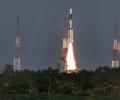
Heralding a new era, India on Friday night launched its heaviest commercial space mission ever with its polar rocket successfully putting five British satellites into the intended orbit after a flawless takeoff.
India on Monday successfully launched Israeli satellite 'Polaris' from the Satish Dhawan Space Centre in Sriharikota by a homegrown Polar Satellite Launch Vehicle, a spokesman of the Indian Space Research Organisation said. This is the second time that a 'core alone' PSLV configuration had put a satellite into orbit. In April 2007, an Italian satellite Agile was put into the orbit, the space agency spokesman said.

'The current launch is a sounding rocket, this cannot be called a milestone. The importance is this is for the first time a private player is doing it.'

Indian astronaut Shubhanshu Shukla and three others were getting ready for their journey to the International Space Station on board SpaceX's Falcon-9 rocket that is scheduled to blast off from the Kennedy Space Centre (KSC) in Florida on Tuesday evening.

Once Aditya L1 reaches its destination, it will help measure various events happening on the Sun for the next five years.
The satellite will enable a full range of services to neighbours including the areas of telecommunication, television, direct-to-home, VSATs, tele-education and tele-medicine.

ISRO aims to send humans into space on a Low Earth Orbit of 400 km for a three-day mission and bring them safely back to earth.

The third and final test in the series of landing experiment (LEX-03) was conducted at 07:10 1ST at the Aeronautical Test Range in Chitradurga, Karnataka.

Four years after it broke many hearts, Indian Space Research Organisation's Chandrayaan is all set to soar towards the moon in its third expedition on Friday in an attempt to put the country in an elite club of nations that accomplished lunar missions with a soft landing.

ISRO said the upper stage of the Polar Satellite Launch Vehicle - C37 (PSLV-C37) re-entered the earth's atmosphere on October 6, 2024 and the impact point was the North Atlantic Ocean.
'The work is already on with various data being studied.'

'When a Project Director is appointed, the whole organization -- including the Chairman ISRO -- works for his success. It is a lesson that has been of abiding value all through the other projects I have worked on,' recalls the late President, one of the earliest pioneers at ISRO.

The ISRO on Sunday scripted yet another history after its LVM3 rocket successfully placed 36 satellites of United Kingdom-based OneWeb group company into intended orbits.
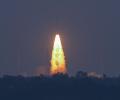
A PSLV rocket carrying Earth observation satellite EOS-09 failed to launch from the Sriharikota spaceport early on Sunday.
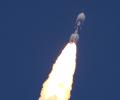
India's first solar mission, if successful, will showcase ISRO's ability to explore the cosmos, explains Kumar Abishek.

India is all set to script history by launching a record number of 22 satellites, including a number of micro and nano ones from foreign countries, in a single mission in May this year.

The 6-metre tall launch vehicle Vikram-S is named after Vikram Sarabhai, the father of the country's space programme and lifted off at 11.30 am.

ISRO's maiden solar mission, Aditya L1, has captured its first high energy X-ray glimpse of solar flares. During its first observation period from approximately October 29, the High Energy L1 Orbiting X-ray Spectrometer (HEL1OS) on board Aditya-L1 spacecraft has recorded the impulsive phase of solar flares, the space agency said in a statement on Tuesday.
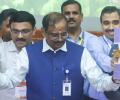
'The satellite's condition is healthy.'

The mission objective is to ensure data continuity of ocean color and wind vector data to sustain the operational applications.
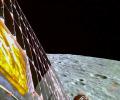
According to the Indian Situational Space Awareness Report for 2023, the nominal lift-off of the Launch Vehicle Mark-3, carrying the Chandrayaan-3 spacecraft, had to be delayed by four seconds based on the Collision on Launch Avoidance analysis.
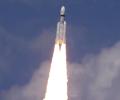
For the Gaganyaan programme, LVM3 rocket is re-configured to meet the human rating requirements and has been christened as 'Human Rated LVM3', ISRO said and it would be capable of launching the Orbital Module to an Low Earth Orbit of 400kms.

"I am extremely happy to announce that GSLV Mark III successfully injected Chandrayaan 2 in the defined orbit, infact the orbit is 6,000 km more than what was intended," Sivan said.

Twice every 12 days, the NISAR satellite will scan nearly all of earth's land and ice surfaces to measure changes in the planet's ecosystems, growth and retreat of its land and sea ice, and deformation of its crust.

Friday's mission is the fourth operational flight of LVM3 which aims to launch the Chandrayaan-3 spacecraft into a Geo Transfer Orbit.

Indian Space Research Organisation (ISRO) will conduct three more test vehicle missions under the ambitious Gaganyaan programme after the maiden TV-D1 test flight, which is scheduled on October 21, the space agency's chairman S Somanath has said.

The third of the total of five orbit raising manoeuvres of the Mars Orbiter spacecraft was performed early on Saturday, raising its apogee, the farthest point from Earth, to over 71,000 km.

The heaviest rocket of the Indian Space Research Organisation -- LVM3-M2/OneWeb India-1 -- blasted off from the Sriharikota spaceport on Sunday to place 36 broadband communication satellites into the Low Earth Orbit (LEO) for a UK-based customer.
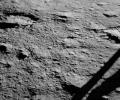
The lessons learned from the failure of Chandrayaan-2 contributed to the success of India's third lunar mission, former space scientist with the Indian Space Research Organisation (ISRO) Nambi Narayanan said, after the successful touchdown of the 'Vikram' lander on the lunar South Pole.

As many as 23 companies have evinced interest in acquiring the Indian space agency's Small Satellite Launch Vehicle technology, said a top official who termed it a "tremendous response". Chairman of Indian National Space Promotion and Authorisation Centre (IN-SPACe) Pawan K Goenka said on Thursday that they are keen to see how the private sector uses the Small Satellite Launch Vehicle (SSLV) technology. "There has been a tremendous response, 23 companies have (so far) shown interest in applying for this technology.

India's observatory will be the fourth in space, after the Hubble, Russia's Spektr R and Suzaku of Japan.

In the first dedicated mission of its commercial arm New Space India Limited (NSIL), the Indian Space Research Organisation on Sunday successfully launched Brazil's earth observation satellite Amazonia-1 and 18 other co-passengers, including five built by students, onboard a Polar rocket from the spaceport in Sriharikota.

Weighing 320 tonne at lift-off, the vehicle used larger strap-on motors to achieve higher payload capability.

According to ISRO officials, the spacecraft will be placed in a halo orbit around Lagrange point 1 (L1) of the Sun-Earth system, about 1.5 million km from the Earth. The L1 point is about one per cent of the total distance between the Earth and the Sun.

The Indian Space Research Organisation on Sunday faced a blip in its plan to tap the small satellite launch vehicle market, as an anomaly in the placing of the satellites by the rocket led to deviation on its path thereby becoming 'no longer usable', Chairman S Somanath said on Sunday.

As more than 400 candidates from a single state -- Haryana -- had taken the test, there are suspicions over whether coaching centres may be involved.
